
Cherokee County Criminal Court Records
A criminal court record is the case-level file kept after the charging decision reaches court. In Cherokee County, felony prosecutions belong in Superior Court, while State Court processes misdemeanor and traffic criminal cases filed with the Clerk. Magistrate Court can appear earlier in the path through first appearances, bond functions, civilian arrest warrant applications, and ordinance matters. The full criminal case file is separate from a jail roster entry, which shows current custody data rather than the court's final outcome.
The District Attorney source is assigned to this criminal court records page because felony prosecution is part of the case path.
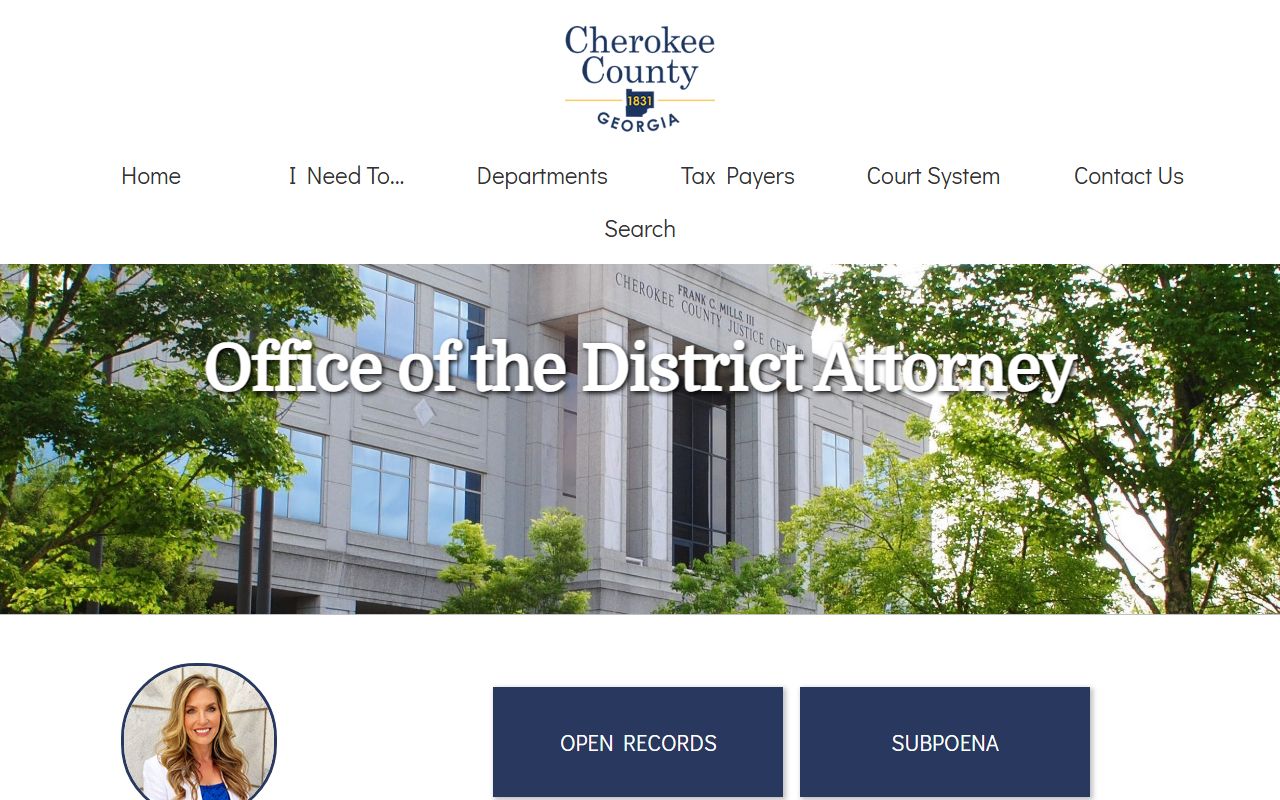
The District Attorney's role helps distinguish the court case file from the arrest event that may have started the matter.
Search Cherokee County Criminal Court Records
Criminal case lookup begins with the Cherokee County Clerk docket search. The search accepts case number, party name, or CSE number. For a criminal case, a defendant name or case number is the common route. Once a case is found, the plus symbol opens docket detail. The docket may show criminal case posture, court dates, judge assignment, and entries tied to charges, pleas, motions, hearings, disposition, and sentencing.
- Open the Clerk docket search and search by criminal case number if available.
- Search by defendant name when the case number is unknown, then confirm the correct court.
- Open the docket detail with the plus symbol next to the case number.
- Read entries for charging papers, arraignment, motions, pleas, hearings, disposition, and sentence.
- Use the Clerk copy process for regular, certified, eCertified, hidden, or complete case documents.
For sentenced state-prison custody, Georgia.gov's offender search is a different source. It is not the Cherokee County criminal court record. It can help locate adults in Georgia Department of Corrections custody after sentencing, while county jail custody is checked through the Sheriff jail list.
Cherokee County Criminal Case Flow
Criminal court records are easiest to read as a sequence. An arrest, citation, or warrant may start the public-safety event, but the court record develops after charges are filed with the court. Cherokee felony matters involve the District Attorney. State Court misdemeanor and traffic criminal matters involve the Solicitor-General. The court file then records hearings, orders, pleas, trial steps, and final disposition.
Case flow: Charges Filed › Arraignment › Pretrial and Motions › Plea or Trial › Disposition › Sentencing
| Stage | What Happens |
|---|---|
| Charges Filed | An accusation, indictment, citation, or related charging paper creates the court case path. |
| Arraignment | The defendant enters the plea process and the court sets early case posture. |
| Pretrial and Motions | Parties file requests, notices, continuances, and orders before plea or trial. |
| Plea or Trial | The case resolves by plea, verdict, dismissal, or another court-approved outcome. |
| Disposition | The docket records how each charge or case was resolved. |
| Sentencing | The court imposes jail, probation, fines, treatment, restitution, or other terms when there is a conviction. |
The District Attorney contact source is also assigned because victim services, trial calendars, and felony prosecution contacts can matter in pending cases.
Prosecutor contact information belongs in the criminal case context, but official record copies still come from the court or Clerk.
What Cherokee County Criminal Records Show
Cherokee County criminal court records may include both high-level docket entries and filed documents. A felony file may show indictment activity, motions, plea documents, orders, trial calendar entries, verdicts, sentencing, probation conditions, and appeals. A State Court criminal file may show misdemeanor or traffic criminal activity, including DUI or failure-to-appear consequences. The exact online view can be less complete than the Clerk's file.
| Field | What It Shows |
|---|---|
| Case Number | The court identifier used for docket lookup and copy requests. |
| Defendant | The person accused in the court case. |
| Court | Superior Court for felonies or State Court for many misdemeanors and traffic criminal matters. |
| Charges | The alleged offenses filed by accusation, indictment, citation, or related charging paper. |
| Plea | The defendant's formal response, such as guilty, not guilty, or another plea form. |
| Motions and Orders | Requests to the judge and court rulings during the case. |
| Disposition | How each charge or the case was resolved. |
| Sentence | Punishment or conditions imposed after conviction, including probation or custody terms when applicable. |
Cherokee Charges vs Convictions
A charge is an accusation. A conviction is a final result based on a guilty plea, verdict, or other qualifying court outcome. Cherokee County criminal court records can show charges that were amended, reduced, dismissed, nolle prossed, or resolved by a plea to a different count. That is why the disposition field matters. Do not treat the presence of a charge as proof of conviction.
| Point | Charge | Conviction |
|---|---|---|
| Meaning | An allegation filed in court. | A final court outcome after plea or verdict. |
| Record Stage | Appears early in the case. | Appears after disposition and sentence. |
| Can Change | May be amended, reduced, dropped, or dismissed. | May be appealed, restricted, or modified only through legal process. |
| Best Field | Charging document and docket entries. | Disposition, sentence, and final order. |
Prosecutors in Cherokee County Cases
Felony criminal cases are prosecuted by the District Attorney for the Blue Ridge Judicial Circuit. The research identifies Susan K. Treadaway as District Attorney, with the office at the Justice Center, Suite 390. Misdemeanor, traffic, and ordinance prosecution routes involve the Solicitor-General. The research identifies Todd Hayes as Solicitor-General and notes State Court traffic and criminal-record restriction links on that office's pages.
The Solicitor-General source appears in the criminal records manifest because misdemeanor and traffic criminal cases can fall under that office.
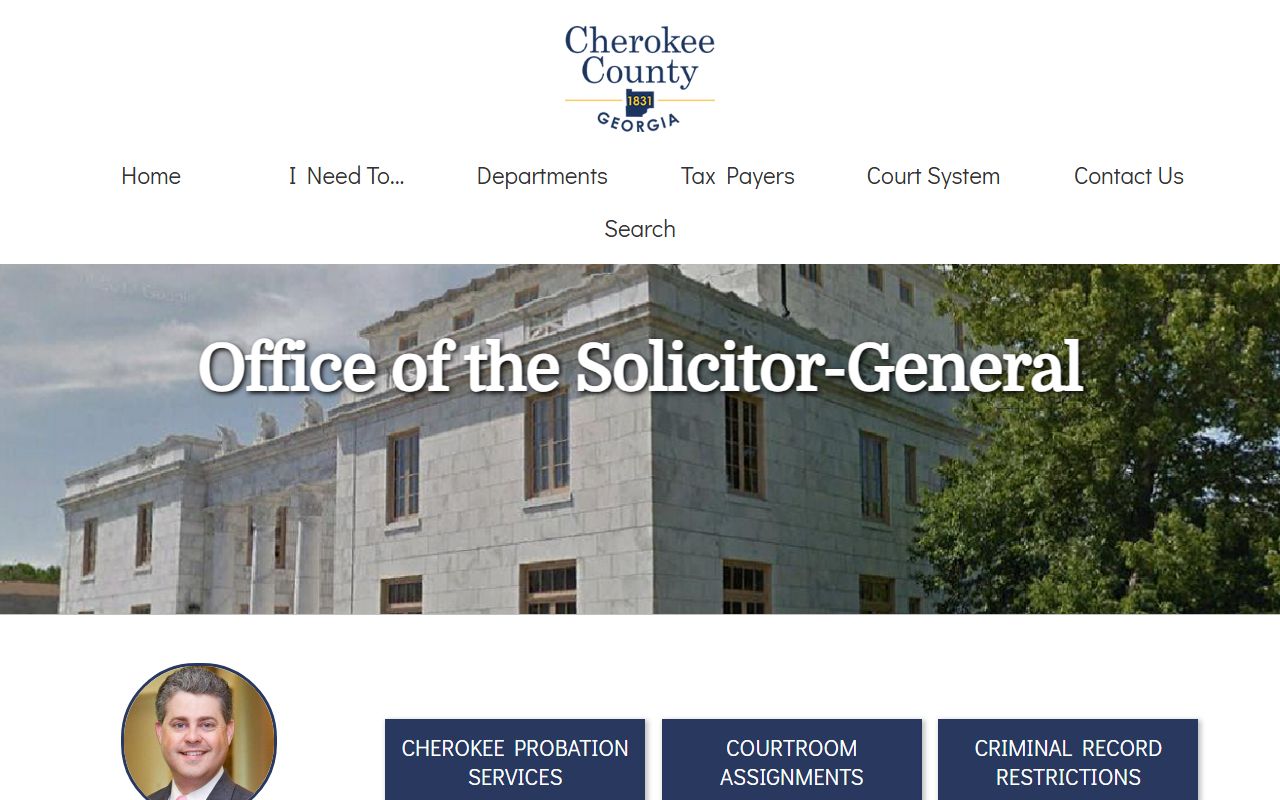
The prosecutor split helps explain why felony and misdemeanor criminal court records can have different charging paths.
Sealed vs Restricted Criminal Records
Georgia often uses record restriction language rather than the older casual term expungement. A sealed record is hidden from public access by law or court order. A restricted criminal-history record limits public dissemination for certain purposes after the proper process. These are not automatic for every dismissal, and they do not always remove every court, jail, or agency reference from every source.
| Point | Sealed | Restricted |
|---|---|---|
| Visibility | Hidden from public access by law or court order. | Limited for non-criminal-justice dissemination after approval. |
| Common Source | Juvenile, adoption, protective, or court-sealed matters. | Eligible arrest cycles under Georgia record restriction rules. |
| Who Handles It | The court with authority over the file. | Applicant, arresting agency, prosecutor, and GCIC path when required. |
| Practical Limit | May still be available to authorized parties. | May not remove every related public court event. |
The criminal record restriction source is assigned to this page because the Sheriff's process applies O.C.G.A. 35-3-37 locally.
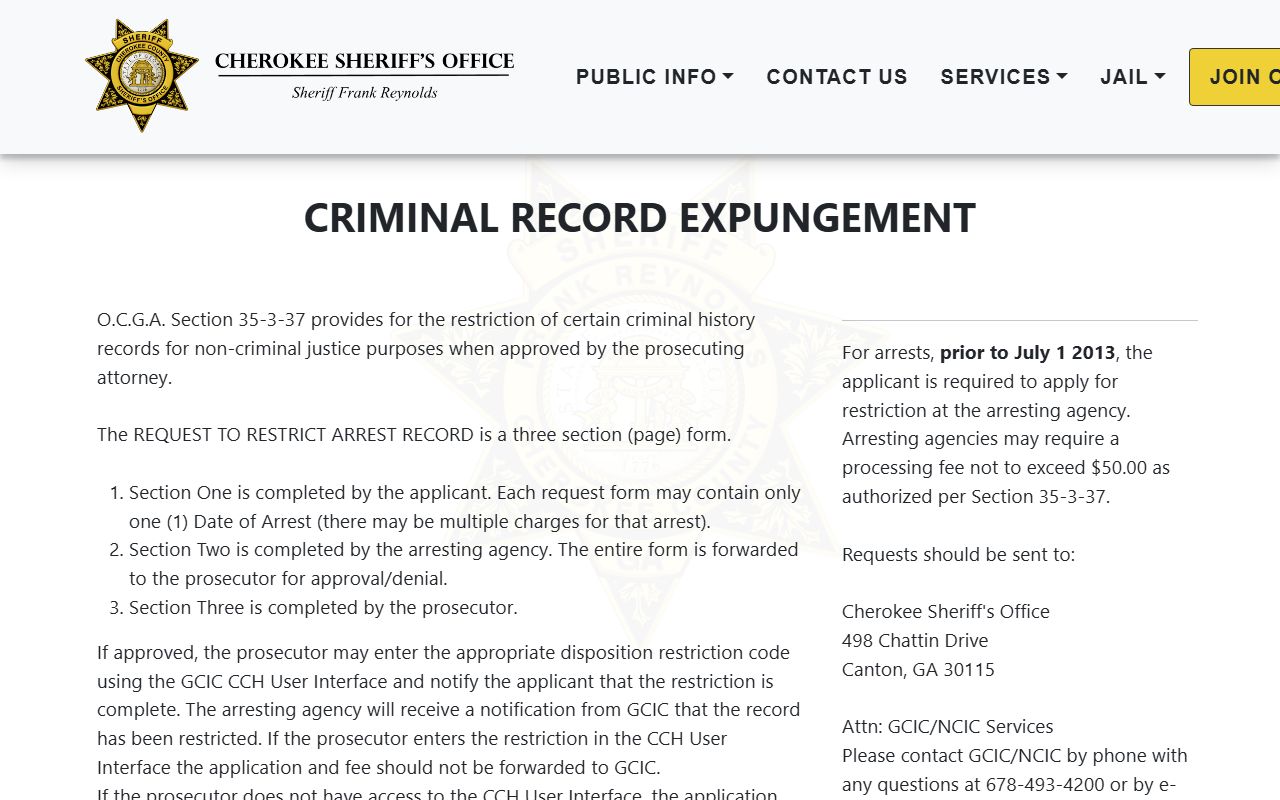
The Sheriff's restriction process is about arrest-cycle dissemination, while the court case file may require separate court analysis.
Public Access to Cherokee Criminal Records
Criminal case files are generally public court records unless a statute, court rule, or order limits access. Georgia's Open Records Act sets a broad public-records presumption, and Uniform Superior Court Rule 21 treats court records as public unless access is limited by law or order. Still, hidden pleadings, sealed matters, juvenile records, adoption records, protected personal data, and treatment-court details can be withheld or redacted.
Note: Online criminal docket entries are useful for case posture, but certified proof comes from the Clerk's copy process.
Court Records and Custody Searches
The court case file is not the same as custody status. Cherokee Sheriff's Office operates the local jail list for people currently in the Adult Detention Center. Georgia.gov's offender search is for adult offenders in Georgia Department of Corrections facilities, not local pretrial jail custody. A person can have a criminal court record without being in jail, and a jail entry can exist before the final court disposition.
The Georgia offender search source is assigned because it is a statewide custody fallback, not a replacement for Cherokee County criminal court records.
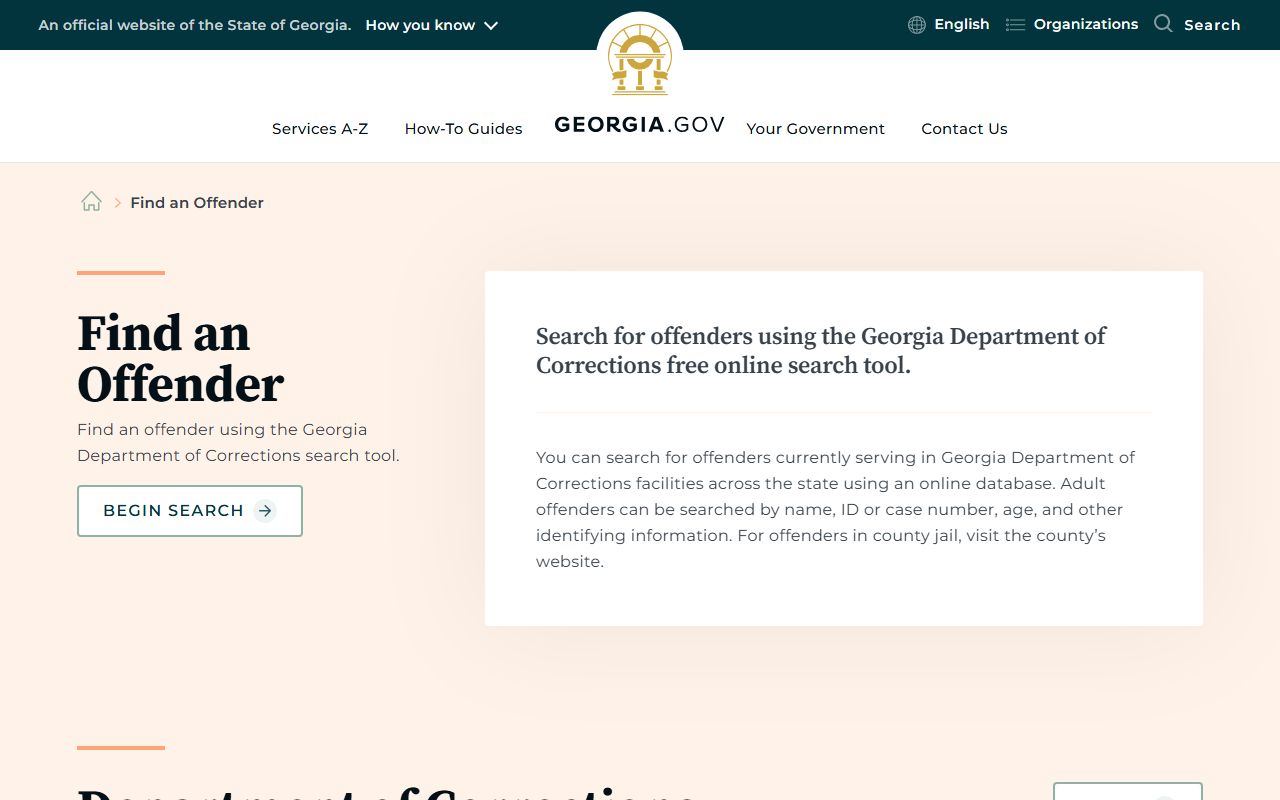
Use the statewide offender guide only after understanding whether the question is about court case history, local jail custody, or state prison status.
Restricted Cherokee Criminal Court Records
Restricted criminal court records in Cherokee County include juvenile cases, sealed cases, certain protective or sensitive pleadings, adoption-related filings, and records with personal identifiers redacted under Georgia filing rules. Treatment accountability court material should not be assumed public. If a criminal case involves a minor, sealed order, or protected victim information, the public docket may omit or hide details.
For complete files, contact the Clerk of Courts at 90 North Street, Suite G-170, Canton, GA 30114. For felony prosecution questions, the District Attorney is in Suite 390. For misdemeanor and traffic prosecution questions, the Solicitor-General is the local prosecuting office. For public defender qualification, Cherokee County Indigent Defense is a separate office and the research lists court-appointed counsel contact routes for people who cannot hire an attorney.